
Reference Design
18K Yellow Gold Emerald Ring
Fine emerald is a study in balance. Color leads the evaluation, but transparency, internal character, treatment, cutting and origin all shape how a stone looks, how rare it is, and how it should be valued.

This 1.44 carat natural Colombian emerald carries GRS’s “Muzo Green” designation, recognizing a particular quality and color profile associated with fine Colombian material. Its vivid green color, transparency, internal character and limited clarity enhancement are best considered together.
The GRS report documents Colombian origin, vivid green color and minor clarity enhancement. The accompanying appendix explains the “Muzo Green” designation while also noting that the designation does not identify the specific mine from which the emerald was recovered.
Most emeralds contain surface-reaching fissures, and clarity enhancement is common. The meaningful questions are how much enhancement is present, what material was used, how the stone looks beneath that enhancement, and whether its value properly reflects those facts.
Education · Transparency · Value
With emerald, I start with the stone—not the country name and not the laboratory report. I want to see a green that feels alive, enough transparency to carry light through the stone, and internal features that do not overpower its beauty.
Treatment matters enormously because it can change how those internal features appear. That is why I want the laboratory report in the conversation early: not to tell me whether the emerald is beautiful, but to tell me what I am actually looking at.
The best emeralds balance beauty, rarity and disclosure. A respected origin can add provenance, but no origin can rescue an ordinary stone—and no unfamiliar origin should cause an exceptional stone to be dismissed.

Reference designs will illustrate how emerald can be interpreted across classic and contemporary settings. Final proportions, metal choices and supporting stones are developed around the individual gemstone and the person who will wear it.


Reference imagery will be added as designs are completed.
Before an emerald becomes a polished gemstone, it begins as part of a geological system, develops its natural crystal form, and is then studied and cut to reveal the color, transparency and character held within.

Emerald begins within its host rock, where unusual geological conditions bring together the elements required for beryl to develop its green color.

Removed from its matrix, the natural crystal reveals the prismatic growth form, surface texture and body color that precede cutting and polishing.

Fine Colombian emeralds can show a pronounced red fluorescence under ultraviolet light. Chromium produces the fluorescence, while the relatively low iron content characteristic of much Colombian material allows that response to remain more visible.
Cutting transforms rough into a finished gemstone, balancing color, transparency, weight retention, durability and the way light moves through the emerald.
No single characteristic defines an exceptional emerald. Color, clarity, treatment, origin, cutting and rarity must be considered together to understand the gemstone as a whole.
Color is the most influential quality factor in emerald. Fine stones typically show a vivid bluish green to pure green, with strong saturation and enough brightness to remain lively rather than becoming overly dark.
Natural emeralds commonly contain visible internal features known in the trade as jardin. Their effect on transparency, beauty and durability matters more than whether the stone is perfectly clean.
Clarity enhancement is common in emerald and can materially affect appearance, rarity and value. The degree of enhancement and the filling material used deserve careful attention and clear disclosure.
Colombia, Zambia, Afghanistan, Pakistan, Russia, Brazil and Ethiopia are among the important sources of emerald. Origin can add provenance and collector interest, but it should support—not replace—evaluation of the individual stone.
Emerald is comparatively brittle and often included, so cutting requires compromise. A successful cut protects vulnerable areas while balancing color, transparency, face-up size and the distribution of light.
Value emerges from the interaction of beauty, transparency, treatment, size, origin and rarity. Exceptional color with limited enhancement becomes increasingly difficult to find as size and quality rise.
Clarity enhancement is common in emerald, but the degree of enhancement matters. A laboratory may report no indications of clarity enhancement or describe the amount of enhancement as minor (F1), moderate (F2), or significant (F3). These designations describe treatment — not the overall quality of the emerald.

Emerald fissures may be filled with oil or resin to reduce their visibility. The type and extent of enhancement can influence appearance, durability, care requirements and value. Color, origin, cut, transparency and overall beauty must still be evaluated separately.
Explore Emerald TreatmentsEmerald occurs in a small number of geologically distinctive regions around the world. Origin can influence history, rarity, appearance and collector interest, but no locality guarantees quality. Color, transparency, clarity, treatment and the beauty of the individual stone remain decisive.
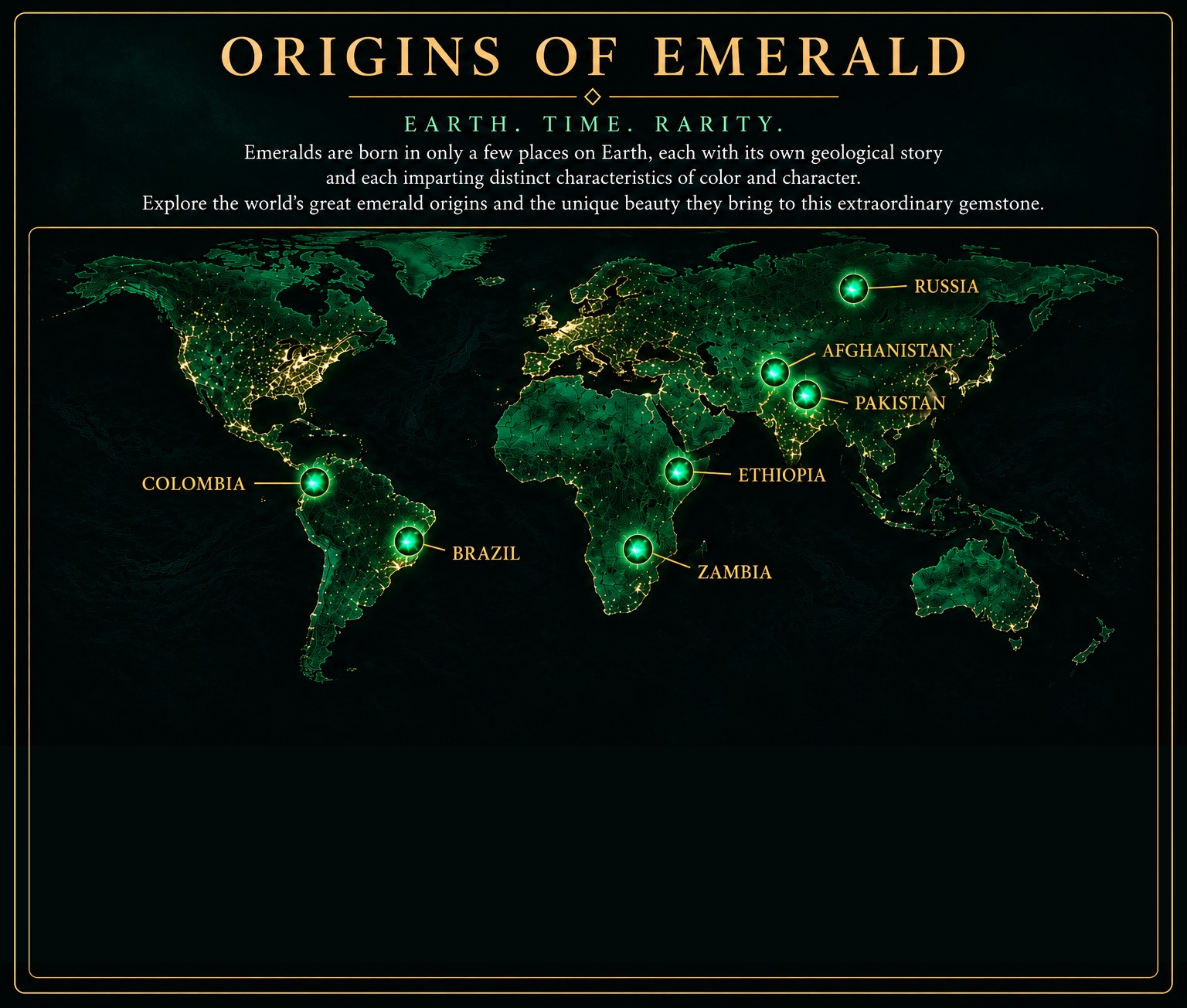
Colombia remains the historic benchmark for fine emerald. Its celebrated mining districts have produced stones renowned for vivid green color, transparency and exceptional provenance.